
Sitemap
A list of all the posts and pages found on the site. For you robots out there, there is an XML version available for digesting as well.
Pages
Posts
Future Blog Post
Published:
This post will show up by default. To disable scheduling of future posts, edit config.yml and set future: false.
Blog Post number 4
Published:
This is a sample blog post. Lorem ipsum I can’t remember the rest of lorem ipsum and don’t have an internet connection right now. Testing testing testing this blog post. Blog posts are cool.
Blog Post number 3
Published:
This is a sample blog post. Lorem ipsum I can’t remember the rest of lorem ipsum and don’t have an internet connection right now. Testing testing testing this blog post. Blog posts are cool.
Blog Post number 2
Published:
This is a sample blog post. Lorem ipsum I can’t remember the rest of lorem ipsum and don’t have an internet connection right now. Testing testing testing this blog post. Blog posts are cool.
Blog Post number 1
Published:
This is a sample blog post. Lorem ipsum I can’t remember the rest of lorem ipsum and don’t have an internet connection right now. Testing testing testing this blog post. Blog posts are cool.
experience
publications
PermalinkA Decentralized Framework for the Optimal Coordination of Distributed Energy Resources
Published in IEEE Transactions on Power Systems, 2018
Abstract Demand-response aggregators are faced with the challenge of how to best manage numerous and heterogeneous distributed energy resources (DERs). This paper proposes a decentralized methodology for optimal coordination of DERs. The proposed approach is based on Dantzig-Wolfe decomposition and column generation, thus allowing to integrate any type of resource whose operation can be formulated within a mixed-integer linear program. We show that the proposed framework offers the same guarantees of optimality as a centralized formulation, with the added benefits of distributed computation, enhanced privacy, and higher robustness to changes in the problem data. The practical efficiency of the algorithm is demonstrated through extensive computational experiments, on a set of instances generated using data from Ontario energy markets. The proposed approach was able to solve all test instances to proven optimality, while achieving significant speed-ups over a centralized formulation solved by state-of-the-art optimization software.
PermalinkLearning chordal extensions
Published in Journal of Global Optimization, 2021
A highly influential ingredient of many techniques designed to exploit sparsity in numerical optimization is the so-called chordal extension of a graph representation of the optimization problem. The definitive relation between chordal extension and the performance of the optimization algorithm that uses the extension is not a mathematically understood task. For this reason, we follow the current research trend of looking at Combinatorial Optimization tasks by using a Machine Learning lens, and we devise a framework for learning elimination rules yielding high-quality chordal extensions. As a first building block of the learning framework, we propose an imitation learning scheme that mimics the elimination ordering provided by an expert rule. Results show that our imitation learning approach is effective in learning two classical elimination rules: the minimum degree and minimum fill-in heuristics, using simple Graph Neural Network models with only a handful of parameters. Moreover, the learned policies display remarkable generalization performance, across both graphs of larger size, and graphs from a different distribution.
PermalinkDesign and implementation of a modular interior-point solver for linear optimization
Published in Mathematical Programming Computations, 2021
Abstract This paper introduces the algorithmic design and implementation of Tulip, an open-source interior-point solver for linear optimization. It implements a regularized homogeneous interior-point algorithm with multiple centrality corrections, and therefore handles unbounded and infeasible problems. The solver is written in Julia, thus allowing for a flexible and efficient implementation: Tulip’s algorithmic framework is fully disentangled from linear algebra implementations and from a model’s arithmetic. In particular, this allows to seamlessly integrate specialized routines for structured problems. Extensive computational results are reported. We find that Tulip is competitive with open-source interior-point solvers on the H. Mittelmann’s benchmark of barrier linear programming solvers. Furthermore, we design specialized linear algebra routines for structured master problems in the context of Dantzig–Wolfe decomposition. These routines yield a tenfold speedup on large and dense instances that arise in power systems operation and two-stage stochastic programming, thereby outperforming state-of-the-art commercial interior point method solvers. Finally, we illustrate Tulip’s ability to use different levels of arithmetic precision by solving problems in extended precision.
PermalinkLearning optimization proxies for large-scale Security-Constrained Economic Dispatch
Published in Electric Power Systems Research, 2022
The Security-Constrained Economic Dispatch (SCED) is a fundamental optimization model for Transmission System Operators (TSO) to clear real-time energy markets while ensuring reliable operations of power grids. In a context of growing operational uncertainty, due to increased penetration of renewable generators and distributed energy resources, operators must continuously monitor risk in real-time, i.e., they must quickly assess the system’s behavior under various changes in load and renewable production. Unfortunately, systematically solving an optimization problem for each such scenario is not practical given the tight constraints of real-time operations. To overcome this limitation, this paper proposes to learn an optimization proxy for SCED, i.e., a Machine Learning (ML) model that can predict an optimal solution for SCED in milliseconds. Motivated by a principled analysis of the market-clearing optimizations of MISO, the paper proposes a novel just-in-time ML pipeline that addresses the main challenges of learning SCED solutions, i.e., the variability in load, renewable output and production costs, as well as the combinatorial structure of commitment decisions. A novel combined classification-plus-regression architecture is also proposed, to further capture the behavior of SCED solutions. Numerical experiments are reported on the French transmission system, and demonstrate the approach’s ability to produce, within a time frame that is compatible with real-time operations, accurate optimization proxies that produce relative errors below 1%.
PermalinkEnd-to-End Feasible Optimization Proxies for Large-Scale Economic Dispatch
Published in IEEE Transactions on Power Systems, 2023
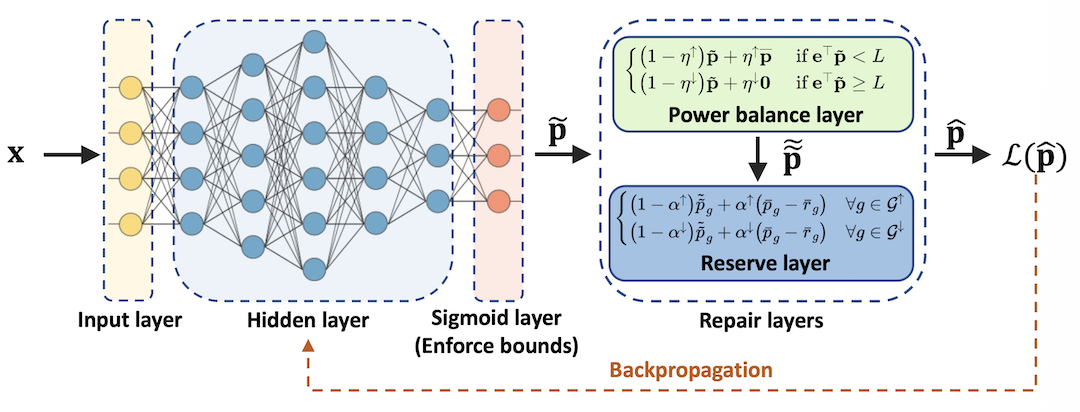
PermalinkReal-time risk analysis with optimization proxies
Published in Electric Power Systems Research, 2024
The increasing penetration of renewable generation and distributed energy resources requires new operating practices for power systems, wherein risk is explicitly quantified and managed. However, traditional risk-assessment frameworks are not fast enough for real-time operations, because they require numerous simulations, each of which requires solving multiple economic dispatch problems sequentially. The paper addresses this computational challenge by proposing proxy-based risk assessment, wherein optimization proxies are trained to learn the input-to-output mapping of an economic dispatch optimization solver. Once trained, the proxies make predictions in milliseconds, thereby enabling real-time risk assessment. The paper leverages self-supervised learning and end-to-end-feasible architecture to achieve high-quality sequential predictions. Numerical experiments on large systems demonstrate the scalability and accuracy of the proposed approach.
PermalinkDual Lagrangian Learning for Conic Optimization
Published in Advances in Neural Information Processing Systems, 2024

PermalinkWeather-informed probabilistic forecasting and scenario generation in power systems
Published in Applied Energy, 2025
The integration of renewable energy sources (RES) into power grids presents significant challenges due to their intrinsic stochasticity and uncertainty, necessitating the development of new techniques for reliable and efficient forecasting. This paper proposes a method combining probabilistic forecasting and Gaussian copula for day-ahead prediction and scenario generation of load, wind, and solar power in high-dimensional contexts. By incorporating historical weather data and weather forecasts as covariates and restoring spatio-temporal correlations, the proposed method enhances the reliability of probabilistic forecasts in RES. Extensive numerical experiments compare the effectiveness of different time series models, with performance evaluated using comprehensive metrics on a real-world and high-dimensional dataset from Midcontinent Independent System Operator (MISO). The results highlight the importance of weather information and demonstrate the efficacy of the Gaussian copula in generating realistic scenarios, with the proposed weather-informed Temporal Fusion Transformer (WI-TFT) model showing superior performance, achieving 49% reduction in load forecasting error, 40% improvement in wind energy prediction, and 34% enhancement in solar energy prediction at individual asset levels compared to non-weather-informed approaches. The integration of copula further improves scenario generation quality, with 2%–7% reduction in energy scores.
PermalinkSelf-Certifying Primal-Dual Optimization Proxies for Large-Scale Batch Economic Dispatch
Published in arXiv, 2025
Abstract Recent research has shown that optimization proxies can be trained to high fidelity, achieving average optimality gaps under 1% for large-scale problems. However, worst-case analyses show that there exist in-distribution queries that result in orders of magnitude higher optimality gap, making it difficult to trust the predictions in practice. This paper aims at striking a balance between classical solvers and optimization proxies in order to enable trustworthy deployments with interpretable speed-optimality tradeoffs based on a user-defined optimality threshold. To this end, the paper proposes a hybrid solver that leverages duality theory to efficiently bound the optimality gap of predictions, falling back to a classical solver for queries where optimality cannot be certified. To improve the achieved speedup of the hybrid solver, the paper proposes an alternative training procedure that combines the primal and dual proxy training. Experiments on large-scale transmission systems show that the hybrid solver is highly scalable. The proposed hybrid solver achieves speedups of over 1000x compared to a parallelized simplex-based solver while guaranteeing a maximum optimality gap of 2%.
software
Portfolio item number 2
Short description of portfolio item number 2 
talks
Talk 1 on Relevant Topic in Your Field
Published:
This is a description of your talk, which is a markdown file that can be all markdown-ified like any other post. Yay markdown!
Conference Proceeding talk 3 on Relevant Topic in Your Field
Published:
This is a description of your conference proceedings talk, note the different field in type. You can put anything in this field.